Astaxanthin is a keto-carotenoid produced primarily by the microalgae Haematococcus pluvialis. It gives salmon, shrimp, and flamingos their characteristic pink-red color. Unlike beta-carotene or lycopene, astaxanthin has a distinct molecular geometry that allows it to embed across the full thickness of a cell membrane rather than clustering in just one layer — a structural property that underlies most of what researchers believe makes it biologically active.
This article explains, as plainly as possible, what scientists currently understand about how astaxanthin interacts with human cells: how it positions itself in membranes, how it neutralizes damaging oxygen species, what signaling pathways it appears to influence, and what early human trials have measured. Where evidence is limited or preliminary, that is stated directly. Nothing here constitutes medical advice.
Key Takeaways
- Astaxanthin’s transmembrane orientation — spanning the full lipid bilayer — distinguishes it from antioxidants that act in only the fat or water phase of cells.
- It quenches singlet oxygen catalytically and scavenges free radicals chemically, with a molecular structure that prevents it from becoming a pro-oxidant.
- Laboratory evidence suggests it modulates NF-κB and Nrf2 pathways, but direct observation of these effects in human tissue at standard doses has not been well established.
- Small human RCTs have measured effects on eye fatigue, UV skin changes, exercise-induced muscle markers, and some inflammatory biomarkers — findings are preliminary and studies are small.
- Fat-soluble and best absorbed with dietary fat; human trials up to 12 mg/day for 12 weeks report no serious adverse effects, though EFSA assessed supplements at a maximum of 8 mg/day against an acceptable daily intake of 0.2 mg/kg body weight.
Astaxanthin's Molecular Structure and Why It Matters
Most carotenoids are hydrophobic — they dissolve in fats and sit within the lipid core of cell membranes. Astaxanthin is different. Its molecule has polar hydroxyl and ketone groups at both ends, attached to a long polyene chain in the middle. This gives it an amphiphilic character: the middle is lipophilic while the end groups are hydrophilic. The result is a molecule that aligns perpendicularly across the lipid bilayer, with its polar ends anchored at each membrane surface and its central chain threading through the hydrophobic interior.
This transmembrane orientation is significant because free radicals and reactive oxygen species attack membranes from both their aqueous and lipid phases. A molecule that spans the full bilayer can theoretically intercept damage on both sides simultaneously. This is a proposed mechanism, not a clinically proven one in every context, but it distinguishes astaxanthin structurally from antioxidants that operate in only one phase, such as vitamin C (aqueous) or vitamin E (lipid-phase only). The description of astaxanthin’s polar-nonpolar-polar layout spanning the full width of the membrane comes from the biochemical literature rather than from any human outcome trial[1].
Singlet Oxygen Quenching and Free Radical Scavenging
Astaxanthin’s primary antioxidant action involves two distinct processes: physical quenching of singlet oxygen and chemical scavenging of free radicals. Singlet oxygen is an excited, highly reactive form of oxygen generated by UV radiation, metabolic processes, and certain immune reactions. Physical quenching means astaxanthin absorbs the excess energy from singlet oxygen and dissipates it as heat, returning the oxygen molecule to its stable ground state without itself being consumed. This makes astaxanthin catalytic in this particular role — one molecule can quench singlet oxygen repeatedly.
In free radical scavenging, astaxanthin donates electrons or hydrogen atoms to neutralize reactive species such as superoxide, hydroxyl radicals, and peroxyl radicals. This process does consume the antioxidant molecule. The long conjugated double-bond system in astaxanthin’s polyene chain stabilizes the resulting astaxanthin radical, preventing it from becoming a pro-oxidant itself — a failure mode seen with some antioxidants at high concentrations.

In laboratory comparisons, astaxanthin has shown substantially higher singlet oxygen quenching capacity than vitamin E and beta-carotene. These are in-vitro measurements and do not directly translate to equivalent clinical effects in humans, where bioavailability, metabolism, and tissue distribution all affect what a compound actually does.
Membrane Integrity and Mitochondrial Protection
Because astaxanthin embeds in cell membranes, it is positioned to reduce lipid peroxidation — the chain reaction in which free radicals strip electrons from membrane fatty acids, producing more radicals and degrading membrane structure. Lipid peroxidation affects membrane fluidity, receptor function, and ion channel behavior. By intercepting the initiating radicals within the membrane, astaxanthin may help preserve the structural integrity of both the outer cell membrane and the membranes of organelles inside the cell.
Mitochondria are of particular interest because they generate the bulk of cellular energy (ATP) through oxidative phosphorylation, and this process inherently produces reactive oxygen species as byproducts. Mitochondrial membranes are rich in polyunsaturated fatty acids, making them vulnerable to oxidative damage. Cell culture and animal studies have shown astaxanthin can localise in mitochondria and preserve mitochondrial membrane potential under oxidative challenge, seen for example in cardiomyocytes exposed to hydrogen peroxide and doxorubicin[2]. Human data demonstrating the same effect in living tissue at standard supplement doses does not exist; every result of this kind comes from cells or animals.
Anti-Inflammatory Signaling Pathways
Beyond direct antioxidant chemistry, astaxanthin appears to modulate cellular signaling pathways associated with inflammation. Laboratory and animal studies have shown it can suppress activation of nuclear factor kappa B (NF-κB), a transcription factor that promotes expression of pro-inflammatory cytokines including TNF-α, IL-1β, and IL-6, and can reduce expression of cyclooxygenase-2 (COX-2), an enzyme central to prostaglandin synthesis and acute inflammation. Both effects were reported together in a single study using human colorectal cancer cells and a mouse colitis model[3]. That is a disease model, not healthy human tissue.
Some research suggests astaxanthin may activate the Nrf2 pathway, which upregulates the body’s own antioxidant defense enzymes such as superoxide dismutase (SOD), catalase, and glutathione peroxidase; the clearest demonstration is in diabetic mice, where oral astaxanthin restored Nrf2-dependent antioxidant signalling[4]. Stimulating endogenous antioxidant systems can be more sustainable than relying solely on exogenous antioxidant molecules. However, most of this mechanistic work has been conducted in cells and rodents. Human trials have measured downstream markers like CRP and cytokine levels rather than directly observing these signaling events in human tissue.
What Early Human Trials Have Measured
Small randomized controlled trials in humans have examined astaxanthin’s effects on specific, measurable outcomes rather than broad disease endpoints. The areas with the most trial activity are eye fatigue (visual accommodation), UV-induced skin changes, exercise-related muscle damage, and inflammatory biomarkers. These trials are generally short (8–12 weeks) and involve small participant numbers, which limits how confident any conclusions can be.
In eye research the honest picture is narrower than it is usually reported. A randomised, double-blind, placebo-controlled trial of astaxanthin alone (9 mg/day, six weeks, 60 adults) found a protective effect on corrected visual acuity after screen work only in participants aged 40 and over, with no significant difference under 40 and no difference at all in functional visual acuity or pupil constriction rate[5]. A separate astaxanthin-only trial in children aged 10 to 14 (4 mg/day, 84 days) did improve computer-vision-syndrome scores by about 20 per cent relative to placebo[6]. The frequently repeated accommodation result, by contrast, comes from a trial of a combination product containing anthocyanin, astaxanthin and lutein, so that benefit cannot be assigned to astaxanthin on its own[7]. In skin research, a meta-analysis of randomised trials found oral astaxanthin significantly improved moisture (SMD 0.53) and elasticity (SMD 0.77) but did not significantly reduce wrinkle depth (SMD -0.26, p = 0.11)[8]. In exercise, a meta-analysis of 24 randomised trials found astaxanthin significantly lowered creatine kinase (SMD -0.45) and lactate dehydrogenase (SMD -0.93), both markers of muscle damage, while producing no significant change in malondialdehyde or interleukin-6 and no significant improvement in VO2max or time-trial performance[9]. The recovery-marker signal is real; the performance signal is not.

Natural astaxanthin from Haematococcus pluvialis has GRAS (Generally Recognized as Safe) status in the United States, and trials up to 12 mg/day for 12 weeks have not identified serious adverse effects. That is not the whole regulatory picture, and the gap matters if you are holding a 12 mg bottle. The European Food Safety Authority assessed astaxanthin supplements at a maximum of 8 mg/day against an acceptable daily intake of 0.2 mg per kg of body weight, roughly 14 mg/day for a 70 kg adult once the astaxanthin already present in fish and shellfish is counted. EFSA concluded that the combined exposure is safe for adults, that adolescents aged 14 to under 18 reach the ADI, and that the ADI is exceeded by 28 per cent in children aged 10 to under 14[10]. A common 12 mg capsule therefore sits close to that ceiling for an adult and above it for a child. Carotenodermia, a reversible yellow-orange tinting of the skin from carotenoid deposition, is often repeated as astaxanthin’s characteristic high-dose effect, but that is a transfer from a different molecule. The roughly 100 documented human cases reviewed in the dermatology literature are cases of high beta-carotene intake, generally above 30 mg/day sustained over months[11], and a PubMed search returns no indexed report of carotenodermia caused by astaxanthin. Astaxanthin is a non-provitamin-A xanthophyll and should not be assumed to behave like beta-carotene in the skin merely because both are carotenoids.
Bioavailability and How Delivery Affects Mechanism
Astaxanthin is a fat-soluble compound. Absorption from the gut is substantially enhanced when taken with a meal containing fat, because dietary fats stimulate bile secretion and the formation of micelles, which package fat-soluble compounds for absorption through intestinal cells. This is measurable rather than theoretical: in healthy volunteers given a single 40 mg dose, three lipid-based formulations produced 1.7 to 3.7 times the plasma exposure of a commercially available astaxanthin supplement, with an elimination half-life of about 16 hours[12]. That was a single-dose comparison against one commercial product, not a general ranking of every capsule type sold today.
After absorption, astaxanthin is transported in the blood primarily within LDL and HDL lipoprotein particles. It accumulates in tissues that are actively metabolizing fat, including the liver, retina, skin, and muscle. The retina is particularly relevant given the eye-fatigue research: the macula already concentrates other carotenoids (lutein and zeaxanthin), and astaxanthin’s ability to reach this tissue is thought to underlie its proposed benefits in visual performance. Actual tissue concentrations achieved by standard supplement doses in humans have not been thoroughly characterized across all tissue types.
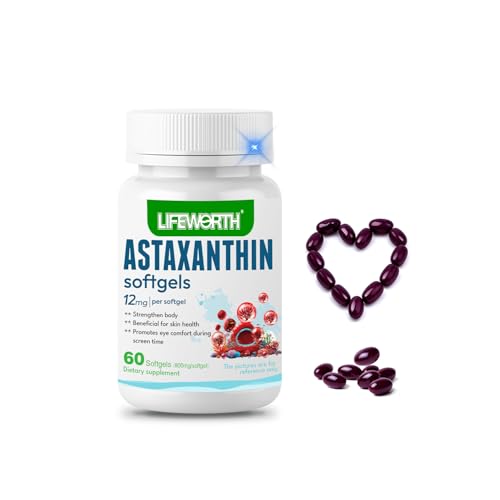
🛒 Where to Buy Astaxanthin
- Nutrex Hawaii BioAstin Hawaiian AstaxanthinLab-tested / studied
softgels, 12 mg per softgel, 90 count — Hawaiian-grown Haematococcus pluvialis, sold as the High Potency 90-softgel bottle - Pure Synergy SuperPure Astaxanthin Extract
capsules, 60 count — Sold as an astaxanthin extract in a capsule rather than a softgel; the listing does not state a mg per capsule, so check the label for the dose before comparing it with the 12 mg bottles here - Naturalis New Zealand Astaxanthin
softgels, 12 mg per softgel, 120 count — New Zealand-grown rather than Hawaiian, and the largest bottle on this list at 120 softgels - NOW Foods Astaxanthin
softgels, 4 mg per softgel — The entry-level 4 mg dose, built on the Zanthin astaxanthin ingredient; a lower starting point than the 12 mg bottles above
As an Amazon Associate we earn from qualifying purchases. Astaxanthin products vary mainly by dose and by source, with 4mg and 12mg the common strengths and most of them derived from Haematococcus pluvialis algae, so check the label for the astaxanthin content per serving and prefer products that publish third-party testing.
A Note on the Evidence
Most human trials on astaxanthin are small, short, and focused on surrogate markers rather than clinical disease outcomes; findings should be treated as preliminary. Astaxanthin supplementation is not recommended during pregnancy or breastfeeding due to insufficient safety data, and anyone with a medical condition or taking prescription medications should consult a qualified healthcare professional before supplementing.
Frequently Asked Questions
How does astaxanthin differ from other antioxidants like vitamin C or vitamin E?
Vitamin C works in the aqueous (water) phase of cells and vitamin E works in the lipid phase, each protecting only one environment. Astaxanthin’s molecular structure lets it span the entire cell membrane, positioning it to intercept oxidative damage in both the lipid interior and at the membrane’s water-facing surfaces simultaneously. This dual-phase action is a proposed advantage, though direct comparative human trials are limited.
Does astaxanthin cross the blood-brain barrier?
Animal studies suggest astaxanthin can reach the brain after oral administration, but reliable human data on brain tissue concentrations at supplement doses is not available. Because it is lipophilic and has a relatively small molecular size, researchers consider it a plausible candidate for blood-brain barrier penetration, but this remains an area where human evidence is lacking.
How long does it take for astaxanthin to build up in the body?
Plasma levels typically stabilize within a few weeks of consistent daily supplementation. Most human trials ran 8–12 weeks before measuring outcomes, suggesting that meaningful tissue accumulation requires sustained intake rather than short-term dosing. The precise timeframe for tissue saturation in humans has not been well characterized across different tissues.
Is synthetic astaxanthin the same as natural astaxanthin?
Synthetic astaxanthin exists as a mixture of stereoisomers, whereas natural astaxanthin from H. pluvialis is predominantly the (3S, 3’S) stereoisomer. These structural differences affect how tightly astaxanthin binds to proteins and membranes. Most human safety and efficacy trials have used natural astaxanthin from H. pluvialis, and GRAS status specifically covers natural astaxanthin. Equivalence between forms in human tissue has not been established.
Can astaxanthin replace other antioxidants in a diet?
No single antioxidant replaces the network effect of diverse dietary antioxidants. Astaxanthin has distinct structural properties and appears to act on different targets than, for example, polyphenols or vitamin C. It is best understood as a complement to a varied diet rather than a replacement for it. Human trials have studied it as an isolated supplement; dietary synergy with other antioxidants in humans has not been specifically studied.
Who should avoid astaxanthin supplements?
Evidence in pregnancy and breastfeeding is insufficient to establish safety, so supplementation is not recommended during those periods. People taking blood-thinning medications, hormone-sensitive medications, or immunosuppressants should consult a physician before adding any supplement. As with any fat-soluble compound, very high doses over time could potentially accumulate. Human trials at 12 mg/day for 12 weeks have not found safety concerns, but the European Food Safety Authority assessed astaxanthin supplements at a maximum of 8 mg/day against an acceptable daily intake of 0.2 mg per kg of body weight, and reported that this intake is exceeded in children aged 10 to under 14. Children should not take an adult astaxanthin dose.
References
- Astaxanthin, cell membrane nutrient with diverse clinical benefits and anti-aging potential. Altern Med Rev (2011). PMID 22214255
- Astaxanthin Reduces H2O2- and Doxorubicin-Induced Cardiotoxicity in H9c2 Cardiomyocyte Cells. Biochemistry (Mosc) (2024). PMID 39523118
- Protective Effects of Astaxanthin against Oxidative Stress: Attenuation of TNF-α-Induced Oxidative Damage in SW480 Cells and Azoxymethane/Dextran Sulfate Sodium-Induced Colitis-Associated Cancer in C57BL/6 Mice. Mar Drugs (2024). PMID 39452878
- Astaxanthin Inhibits Diabetes-Triggered Periodontal Destruction, Ameliorates Oxidative Complications in STZ-Injected Mice, and Recovers Nrf2-Dependent Antioxidant System. Nutrients (2021). PMID 34684576
- Effects of diet containing astaxanthin on visual function in healthy individuals: a randomized, double-blind, placebo-controlled, parallel study. J Clin Biochem Nutr (2023). PMID 36777084
- Astaxanthin (AstaReal) Improved Acute and Chronic Digital Eye Strain in Children: A Randomized Double-Blind Placebo-Controlled Trial. Adv Ther (2025). PMID 40014233
- Effects of anthocyanin, astaxanthin, and lutein on eye functions: a randomized, double-blind, placebo-controlled study. J Clin Biochem Nutr (2021). PMID 34376917
- Systematic Review and Meta-Analysis on the Effects of Astaxanthin on Human Skin Ageing. Nutrients (2021). PMID 34578794
- The Effects of Astaxanthin Supplementation on Exercise Recovery Biomarkers and Exercise Performance: A Systematic Review and Meta-Analysis. Nutrients (2026). PMID 42197030
- Safety of astaxanthin for its use as a novel food in food supplements. EFSA J (2020). PMID 32874213
- Diet-induced carotenodermia: a literature review. Int J Dermatol (2024). PMID 37916485
- Oral bioavailability of the antioxidant astaxanthin in humans is enhanced by incorporation of lipid based formulations. Eur J Pharm Sci (2003). PMID 12885395
These statements have not been evaluated by the Food and Drug Administration. This information is not intended to diagnose, treat, cure, or prevent any disease. Content is for informational purposes only and is not medical advice; consult a qualified healthcare provider before starting any supplement. As an Amazon Associate we earn from qualifying purchases.
