Astaxanthin is a keto-carotenoid produced naturally by the microalgae Haematococcus pluvialis, and it has attracted steady scientific interest for its unusually broad antioxidant activity. Unlike most antioxidants, astaxanthin is both fat-soluble and capable of interacting with the aqueous regions of cell membranes, which means it can quench free radicals and singlet oxygen across the full thickness of a cell membrane — a property most single-phase antioxidants lack.
If you are shopping for an astaxanthin supplement, you have almost certainly noticed that products cluster around two doses: 4 mg and 12 mg per serving. The difference is not arbitrary. Early human trials have explored different dose ranges for different outcomes, and tolerability data sets a practical upper boundary for everyday use. This article walks through what is known about each dose, who each dose is likely to suit, and where the honest limits of current evidence lie.
Key Takeaways
- 4 mg daily is well-studied for eye fatigue, skin health, and general antioxidant support, and represents a sensible starting dose for most people.
- 12 mg daily sits comfortably inside the studied range rather than at its ceiling: a 2019 safety review of 87 human studies found none reporting safety concerns, and 35 of them used 12 mg per day or more[1]. It is the level most used in exercise-recovery trials.
- Natural astaxanthin from Haematococcus pluvialis holds GRAS status and has shown no serious adverse effects at up to 12 mg/day for 12 weeks in available trials.
- Take astaxanthin with a fat-containing meal at either dose to support absorption; the molecule is fat-soluble.
- Supplementation is not recommended during pregnancy or breastfeeding due to insufficient evidence in those populations.
How Astaxanthin Works in the Body
Astaxanthin belongs to the carotenoid family but differs structurally from beta-carotene or lycopene because it carries polar end groups (keto and hydroxyl groups) on both ends of its long conjugated chain. This dual polarity allows the molecule to anchor across a lipid bilayer with its polar ends interacting with the hydrophilic surface and its middle spanning the hydrophobic core. The result is a molecule that can intercept reactive oxygen species in both the membrane interior and the surrounding aqueous environment.
In practical terms this membrane-spanning architecture is thought to contribute to the antioxidant potency observed in laboratory assays, and it may partly explain why human trials have found measurable effects on outcomes tied to oxidative stress — eye fatigue after prolonged screen use, UV-related changes in skin, post-exercise muscle soreness, and circulating inflammatory markers. It is important to note, however, that laboratory potency does not automatically translate to equivalent clinical benefit; dose, bioavailability, and the specific biological target all matter.
Natural astaxanthin from Haematococcus pluvialis is the form used in most human research and is the form that holds Generally Recognized as Safe (GRAS) status in the United States. Synthetic astaxanthin exists and is widely used in aquaculture but has a different stereochemical profile and has not been evaluated as thoroughly in human studies.
What Research Areas Have Used 4 mg?
A 4 mg daily dose appears in trials on eye strain and on skin quality, though it is worth being precise about what each one actually tested. The clearest standalone 4 mg result for digital eye strain comes from an 84-day randomized placebo-controlled trial — but it was run in 64 children aged 10 to 14, not adults[2]. A frequently cited adult eye-function trial used a combination capsule containing anthocyanin, astaxanthin and lutein together, so its result cannot be attributed to astaxanthin alone[3]. On skin, a 10-week randomized placebo-controlled trial gave 4 mg of astaxanthin daily and reported an increased minimal erythema dose and reduced moisture loss in UV-irradiated skin — a genuine standalone 4 mg result, though in only 23 participants[4].


The appeal of 4 mg from a product formulation standpoint is that it sits comfortably within a range that has shown no meaningful safety signals in trials of reasonable duration. For people new to astaxanthin, or for those using it primarily for general antioxidant support or mild eye-comfort benefits, 4 mg represents a reasonable and well-tolerated starting point.
It is worth being honest that the human trial literature on astaxanthin remains relatively early-stage. Many published studies involve small participant counts and relatively short durations. Measured effects have generally been modest rather than dramatic, and no trial has established astaxanthin as a treatment for any medical condition.
What Research Areas Have Used 12 mg?
A 12 mg daily dose is best understood as a well-populated point in the literature rather than an upper limit. The 2019 safety review found approved or recommended doses ranging from 2 mg to 24 mg depending on the country, and 35 of the 87 human studies it examined used 12 mg per day or above[1]. The dose appears in trials examining exercise-related outcomes — specifically markers of muscle damage and oxidative stress following strenuous physical activity — as well as in longer-duration skin aging studies. Trials exploring effects on lipid oxidation and C-reactive protein levels have also used doses in this range.
For physically active adults who train regularly and experience exercise-induced muscle soreness, a 12 mg dose is the level most studied for that application. Results in this space have been mixed, and the null results deserve as much weight as the positive ones: a crossover trial supplementing resistance-trained men with 12 mg per day for four weeks found no effect on creatine kinase, C-reactive protein, interleukin-6 or delayed-onset muscle soreness after a muscle-damage protocol[5]. The heterogeneity in outcomes likely reflects differences in participant fitness levels, exercise protocols, and measurement timing — and the honest summary is that astaxanthin is not an established recovery aid at any dose.
Twelve milligrams per day for up to 12 weeks has not produced serious adverse effects in available trial data, which supports its use as a practical upper dose for most healthy adults. Going substantially above 12 mg is not well-studied in humans and is not necessary based on current evidence.
Choosing Between 4 mg and 12 mg: A Practical Framework
The right dose depends on your primary reason for taking astaxanthin and your individual tolerance preferences. If your main interest is general antioxidant support, mild eye comfort during screen-heavy days, or skin health, 4 mg is a sensible starting point with a well-established tolerability profile. Many people find 4 mg sufficient for these purposes and see no reason to increase.
If you are a regularly training athlete looking to support recovery from strenuous exercise, or if you are pursuing the skin aging or inflammatory marker outcomes that higher-dose trials have examined, 12 mg is the dose most relevant to that research. It is still within the safety-reviewed range and does not require exceeding what has been studied.


A practical middle path some users follow is beginning at 4 mg for the first few weeks to assess individual response, then increasing to 12 mg if the lower dose feels insufficient for their goals. Because astaxanthin is fat-soluble, taking it with a meal that contains some dietary fat improves absorption, and the size of that effect is not trivial: a pharmacokinetic study of Haematococcus algal extract measured roughly 2.4 times the plasma exposure when the dose was taken after a meal rather than before one[6]. This applies at both dose levels.
Safety, Side Effects, and Who Should Exercise Caution
Natural astaxanthin from Haematococcus pluvialis has a reassuring human safety record: a 2019 review examined 87 human studies and found none reporting safety concerns, including 35 conducted at 12 mg per day or above[1]. One correction is worth making here, because it is repeated widely in supplement writing: carotenodermia — the reversible yellow-orange skin tint caused by carotenoid accumulation — is well documented for high beta-carotene intake, but it has not been reported in the published human astaxanthin trial literature, and the commonly repeated threshold of “above 20 mg per day” does not trace to an astaxanthin study. The largest published trial at that dose gave 20 mg per day for four weeks to 32 trained cyclists and recorded no such effect[7]. Skin discoloration is not a documented concern anywhere in the 4 mg to 12 mg range used in most research.
Evidence in pregnancy and breastfeeding is insufficient to establish safety, so supplementation is not recommended during those periods. People taking anticoagulants or blood pressure medications should consult a healthcare provider before adding astaxanthin, as theoretical interactions exist based on mechanism, even though direct drug interaction studies in humans are limited. Anyone with known carotenoid sensitivity or allergy to algae-derived products should also seek medical guidance before use.
Sourcing and Quality Considerations
Not all astaxanthin products are equivalent. Natural astaxanthin from Haematococcus pluvialis is the form used in human research and the form with GRAS status. Synthetic astaxanthin, while legal in some food applications, has a different stereochemical composition and is not backed by the same human safety and efficacy data. When selecting a supplement, look for products that specify the source as Haematococcus pluvialis and ideally provide third-party testing documentation.
Astaxanthin oxidizes over time when exposed to light and heat. Quality products are packaged in opaque or dark containers and stored away from direct light. Softgel capsules with oil-based formulations generally offer better bioavailability than dry powder capsules because the fat matrix supports absorption of this lipophilic compound.
🛒 Where to Buy Astaxanthin
- Nutrex Hawaii BioAstin Hawaiian AstaxanthinLab-tested / studied
softgels, 12 mg per softgel, 90 count — Hawaiian-grown Haematococcus pluvialis, sold as the High Potency 90-softgel bottle - Pure Synergy SuperPure Astaxanthin Extract
capsules, 60 count — Sold as an astaxanthin extract in a capsule rather than a softgel; the listing does not state a mg per capsule, so check the label for the dose before comparing it with the 12 mg bottles here - Naturalis New Zealand Astaxanthin
softgels, 12 mg per softgel, 120 count — New Zealand-grown rather than Hawaiian, and the largest bottle on this list at 120 softgels - NOW Foods Astaxanthin
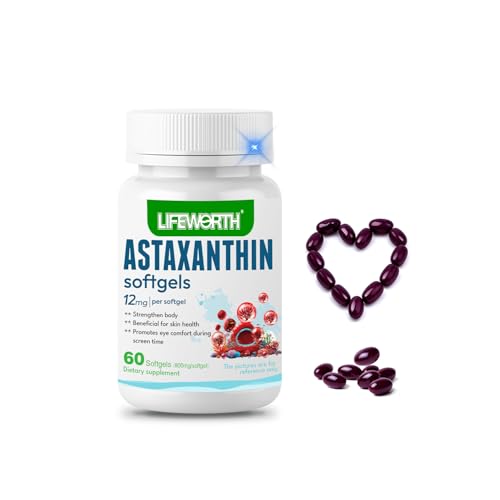
softgels, 4 mg per softgel — The entry-level 4 mg dose, built on the Zanthin astaxanthin ingredient; a lower starting point than the 12 mg bottles above
As an Amazon Associate we earn from qualifying purchases. Astaxanthin products vary mainly by dose and by source, with 4mg and 12mg the common strengths and most of them derived from Haematococcus pluvialis algae, so check the label for the astaxanthin content per serving and prefer products that publish third-party testing.
A Note on the Evidence
The human research on astaxanthin remains early-stage — most trials are small, short in duration, and have not been independently replicated at scale; measured effects have generally been modest. This article is informational only and does not constitute medical advice; consult a qualified healthcare provider before starting any supplement, particularly if you are pregnant, breastfeeding, taking prescription medications, or managing a health condition.

Frequently Asked Questions
Is 4 mg of astaxanthin enough to notice any effect?
Four milligrams is the dose studied most often for eye comfort and skin-related outcomes in early human trials, and some participants in those trials did report measurable improvements in the relevant endpoints. Whether any individual notices a subjective effect depends on their baseline, the outcome they are targeting, and how long they supplement — most trials ran for 4 to 12 weeks before measuring outcomes.
Can I take 12 mg of astaxanthin every day long-term?
Available human safety data covers doses up to 12 mg per day for up to 12 weeks without serious adverse events. Long-term data beyond that window is limited, so it is not possible to make definitive statements about use beyond 12 weeks. If you plan extended use, periodic check-ins with a healthcare provider are reasonable.
What is the skin discoloration side effect and does it happen at 12 mg?
Carotenodermia — a reversible yellow-orange tint to the skin — is well documented for high beta-carotene intake, but it has not been reported in the published human astaxanthin trial literature. The “above 20 mg per day” threshold often repeated for astaxanthin does not trace to an astaxanthin study: a four-week trial that gave 20 mg per day to 32 trained cyclists recorded no such effect[7]. At the 4 mg to 12 mg range covered by most human trials, skin discoloration is not a documented concern.
Does it matter whether I take 4 mg or 12 mg with food?
Yes, and this applies at both dose levels. Astaxanthin is fat-soluble, meaning it is absorbed more efficiently when consumed alongside dietary fat. A pharmacokinetic study measured roughly 2.4 times the plasma exposure when the dose was taken after a meal rather than before one[6], so taking your supplement with a meal that contains some fat meaningfully improves bioavailability compared to taking it on an empty stomach.
Is natural astaxanthin really different from synthetic astaxanthin?
Natural astaxanthin from Haematococcus pluvialis and synthetic astaxanthin differ in their stereochemical structure. The natural form exists predominantly as the 3S,3’S enantiomer complexed with fatty acids, while synthetic astaxanthin is a racemic mixture of stereoisomers. Most human research and all GRAS safety evaluations involve the natural form, so when selecting a supplement, the source matters.
Why should pregnant or breastfeeding people avoid astaxanthin?
Human trial data on astaxanthin has generally excluded pregnant and breastfeeding individuals, meaning there is no adequate evidence base to confirm safety during those periods. In the absence of sufficient data, supplementation during pregnancy or breastfeeding is not recommended. Anyone in those categories with a specific interest in astaxanthin should consult an obstetrician or midwife before use.
References
- Brendler et al. Astaxanthin: How much is too much? A safety review. Phytotherapy Research (2019). PMID 31788888
- Hecht et al. Astaxanthin (AstaReal) Improved Acute and Chronic Digital Eye Strain in Children: A Randomized Double-Blind Placebo-Controlled Trial. Advances in Therapy (2025). PMID 40014233
- Kizawa et al. Effects of anthocyanin, astaxanthin, and lutein on eye functions: a randomized, double-blind, placebo-controlled study. Journal of Clinical Biochemistry and Nutrition (2021). PMID 34376917
- Ito et al. The Protective Role of Astaxanthin for UV-Induced Skin Deterioration in Healthy People – A Randomized, Double-Blind, Placebo-Controlled Trial. Nutrients (2018). PMID 29941810
- Waldman et al. Astaxanthin Supplementation Does Not Affect Markers of Muscle Damage or Inflammation After an Exercise-Induced Muscle Damage Protocol in Resistance-Trained Males. Journal of Strength and Conditioning Research (2023). PMID 36727984
- Okada et al. Bioavailability of astaxanthin in Haematococcus algal extract: the effects of timing of diet and smoking habits. Bioscience, Biotechnology, and Biochemistry (2009). PMID 19734684
- Res et al. Astaxanthin supplementation does not augment fat use or improve endurance performance. Medicine & Science in Sports & Exercise (2013). PMID 23274592
These statements have not been evaluated by the Food and Drug Administration. This information is not intended to diagnose, treat, cure, or prevent any disease. Content is for informational purposes only and is not medical advice; consult a qualified healthcare provider before starting any supplement. As an Amazon Associate we earn from qualifying purchases.
