Astaxanthin is a keto-carotenoid produced primarily by the microalgae Haematococcus pluvialis. Unlike most antioxidants, it integrates into both the lipid and aqueous layers of cell membranes, allowing it to intercept free radicals and quench singlet oxygen across tissue compartments. Joints generate substantial oxidative stress during inflammation, making this membrane-spanning property potentially relevant to conditions like osteoarthritis and rheumatoid arthritis.
Interest in astaxanthin for joint pain has grown alongside a broader search for anti-inflammatory compounds with favorable safety profiles. A handful of randomized controlled trials and a growing body of preclinical research now address this topic. The evidence is still early, but directionally consistent. This article reviews what the data actually show, where the gaps remain, and what someone considering supplementation should realistically expect.
Key Takeaways
- A 2025 RCT found astaxanthin improved clinical outcomes, quality of life, and inflammatory markers in rheumatoid arthritis patients — the most direct standalone human evidence available [1].
- Combination products containing astaxanthin alongside krill oil or hyaluronic acid showed joint pain benefits in osteoarthritis RCTs, though isolating astaxanthin’s specific contribution remains difficult [2][3].
- Preclinical research shows astaxanthin activates the Nrf2 antioxidant pathway, suppresses chondrocyte pyroptosis, and modulates synovial macrophages — mechanistic targets relevant to both OA and RA [4][5][6].
- Natural astaxanthin is generally well-tolerated at 4–12 mg/day; the main reported side effect at very high doses is reversible skin discoloration (carotenodermia).
- The human evidence base remains small and mostly short-term — further dedicated single-ingredient trials are needed before strong clinical recommendations can be made for joint health specifically.
How Astaxanthin May Protect Cartilage: Proposed Mechanisms
Cartilage degradation in osteoarthritis involves oxidative damage to chondrocytes — the cells that maintain cartilage matrix — alongside inflammatory cytokine cascades and impaired cellular repair. Astaxanthin’s proposed role centers on two overlapping pathways. As a potent free-radical scavenger, it may reduce the oxidative burden inside chondrocytes. It also appears to activate Nrf2, a transcription factor that upregulates the body’s own antioxidant defense enzymes. A 2019 study found that astaxanthin protected against osteoarthritis progression through this Nrf2 pathway, preserving cartilage homeostasis and reducing matrix breakdown [4].
Inflammation in joint disease also involves macrophages within the synovial membrane — the tissue lining the joint capsule. Laboratory research using astaxanthin-loaded liposomes showed that targeting synovial macrophages with astaxanthin reduced oxidative stress and inflammatory signaling within the joint environment [6]. A 2024 study using a novel delivery scaffold separately demonstrated that astaxanthin suppressed chondrocyte pyroptosis, a form of inflammatory cell death, and modulated oxidative stress in an osteoarthritis model [5]. These preclinical findings help explain why researchers have moved toward human trials, though animal and cell-based results do not guarantee equivalent effects in people.
Astaxanthin and Osteoarthritis: Human Trial Data
The most direct human evidence for astaxanthin in osteoarthritis comes from a multicenter, randomized, double-blind, placebo-controlled trial that tested a combination supplement containing krill oil, astaxanthin, and oral hyaluronic acid in adults with mild osteoarthritis. The trial found meaningful improvements in joint pain and function in the active group compared to placebo [2]. Because krill oil also contains EPA and DHA omega-3 fatty acids, the relative contribution of astaxanthin alone cannot be cleanly isolated from this result.

A related 6-month multicenter RCT evaluated krill oil specifically in adults with mild to moderate knee osteoarthritis and found it improved knee pain versus placebo [3]. Again, krill oil is a multi-component product: astaxanthin is present but omega-3s are the dominant active constituent by mass. Both trials suggest the combination formulations are beneficial for osteoarthritis-related pain, but isolating astaxanthin’s independent contribution in humans remains an open question that single-ingredient trials would be better suited to answer.

Astaxanthin in Rheumatoid Arthritis: A Dedicated Clinical Trial
Unlike osteoarthritis — primarily a degenerative joint disease — rheumatoid arthritis is an autoimmune condition characterized by chronic synovial inflammation, joint erosion, and elevated systemic inflammatory markers. A 2025 randomized clinical trial tested astaxanthin supplementation specifically in rheumatoid arthritis patients and found improvements in clinical outcomes, quality of life scores, and inflammatory factors compared to a control group [1]. This is currently the most direct human evidence for astaxanthin as a standalone supplement in an arthritis population.
The result is biologically plausible because rheumatoid arthritis is driven partly by oxidative stress and macrophage-mediated inflammation — precisely the pathways astaxanthin is proposed to modulate. That said, a single trial is preliminary. The effect sizes, participant count, specific inflammatory markers that changed, and whether structural joint damage was assessed are all details that matter when interpreting how much clinical weight to assign this finding. Replication in larger independent trials is needed.
Combination Formulations: What the Evidence Can and Cannot Tell Us
Several joint-health trials use astaxanthin as one ingredient among several, a common pattern in supplement research that complicates conclusions about any single component. A 2023 trial assessed a multi-ingredient tablet formulation for joint pain and inflammation management in arthritis patients and reported positive outcomes for both safety and effectiveness [7]. As with krill oil trials, attributing observed benefits to astaxanthin specifically requires caution when other active ingredients are present.
This distinction matters practically when evaluating products on the market. Many joint supplements combine astaxanthin with glucosamine, chondroitin, omega-3s, or hyaluronic acid. If those combinations show benefit in trials, that finding is meaningful — but it does not confirm that an equivalent dose of isolated astaxanthin would produce the same result. Reviewing which exact formulation was studied in any given trial is essential before drawing product-level conclusions.
Bone Health: A Related but Distinct Area of Research
Joint health encompasses not only cartilage and synovial tissue but the underlying bone. A 2023 review assessed the evidence for astaxanthin’s effects on bone, concluding that its antioxidant and anti-inflammatory properties show potential for supporting bone homeostasis — the balance between bone formation and resorption [8]. Oxidative stress is implicated in bone-density loss, and astaxanthin’s systemic antioxidant activity may have downstream relevance for bone health over time. The reviewed evidence was predominantly preclinical, meaning dedicated human trials on bone endpoints remain limited.

Dosing, Absorption, and Safety
Natural astaxanthin from Haematococcus pluvialis holds GRAS (Generally Recognized as Safe) status in the United States. Human trials have generally used doses in the range of 4–12 mg per day, and no serious adverse effects have been reported at these levels in trials lasting up to 12 weeks. The one consistently noted side effect at higher doses — above approximately 20 mg/day — is carotenodermia, a reversible yellow-orange tinting of the skin caused by carotenoid accumulation in subcutaneous fat. This is benign and resolves upon stopping supplementation.

As a fat-soluble compound, astaxanthin is better absorbed when taken with a meal containing dietary fat. Evidence during pregnancy or breastfeeding is insufficient to support supplementation in those populations, and that use is not recommended. Anyone taking anticoagulant medications or drugs that affect oxidative stress pathways should consult a healthcare provider before adding astaxanthin, as clinical interaction data are limited.
🛒 Where to Buy Astaxanthin
- Nutrex Hawaii BioAstin Hawaiian AstaxanthinLab-tested / studied
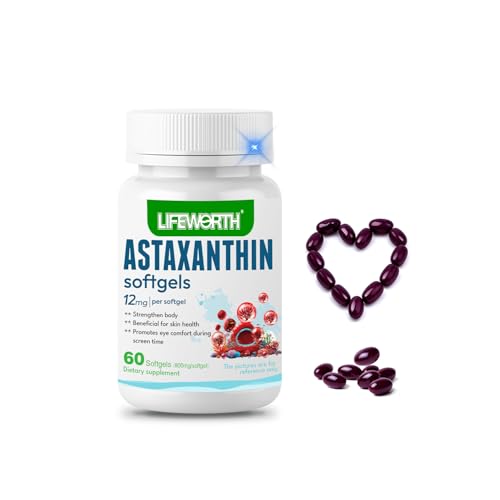
softgels, 12 mg per softgel, 90 count — Hawaiian-grown Haematococcus pluvialis, sold as the High Potency 90-softgel bottle - Pure Synergy SuperPure Astaxanthin Extract
capsules, 60 count — Sold as an astaxanthin extract in a capsule rather than a softgel; the listing does not state a mg per capsule, so check the label for the dose before comparing it with the 12 mg bottles here - Naturalis New Zealand Astaxanthin
softgels, 12 mg per softgel, 120 count — New Zealand-grown rather than Hawaiian, and the largest bottle on this list at 120 softgels - NOW Foods Astaxanthin
softgels, 4 mg per softgel — The entry-level 4 mg dose, built on the Zanthin astaxanthin ingredient; a lower starting point than the 12 mg bottles above
As an Amazon Associate we earn from qualifying purchases. Astaxanthin products vary mainly by dose and by source, with 4mg and 12mg the common strengths and most of them derived from Haematococcus pluvialis algae, so check the label for the astaxanthin content per serving and prefer products that publish third-party testing.
A Note on the Evidence
The human trial evidence for astaxanthin and joint health remains limited in both scale and duration; most studies are short-term, several use multi-ingredient formulations, and replication in large independent trials is lacking — so findings should be treated as preliminary. Supplementation is not recommended during pregnancy or breastfeeding due to insufficient safety data, and individuals with medical conditions or taking medications should consult a healthcare provider before use. This article is informational only and does not constitute medical advice.
Frequently Asked Questions
Does astaxanthin reduce joint pain in humans?
Human trials using astaxanthin-containing combinations found improvements in joint pain in osteoarthritis populations [2][3], and a 2025 RCT using standalone astaxanthin in rheumatoid arthritis patients showed improvements in clinical outcomes [1]. The evidence is promising but the trials are small and often multi-ingredient, so definitive conclusions await larger replication studies.
How does astaxanthin work against joint inflammation?
Astaxanthin is proposed to act through at least two pathways: activating Nrf2 to upregulate the body’s own antioxidant enzymes [4] and modulating synovial macrophages, the immune cells that drive inflammation within the joint lining [6]. It has also been shown in cell models to suppress chondrocyte pyroptosis — a form of inflammatory cell death that contributes to cartilage loss [5]. These mechanisms are supported by preclinical rather than human mechanistic data.
Is astaxanthin specifically studied for rheumatoid arthritis?
Yes. A 2025 randomized clinical trial tested astaxanthin as a standalone supplement in rheumatoid arthritis patients and found it improved clinical outcomes, quality of life, and inflammatory factors versus a control group [1]. This is an encouraging finding, but it represents a single trial and should be considered preliminary until replicated in larger studies.
What dose of astaxanthin is used in joint health research?
Most human trials have used doses in the range of 4–12 mg per day. Because astaxanthin is fat-soluble, it is better absorbed when taken with a fat-containing meal. No serious adverse effects have been reported at these doses in trials lasting up to 12 weeks, and GRAS status applies to natural astaxanthin from H. pluvialis.

Can astaxanthin replace arthritis medication?
No. In the available trials, astaxanthin was studied as a supplement used alongside standard care, not as a replacement for disease-modifying drugs or prescribed pain management. Anyone with a diagnosed arthritis condition should manage their care under medical supervision and discuss any supplement additions with their doctor before starting.
Does astaxanthin protect cartilage directly?
Preclinical studies suggest it can protect chondrocytes from oxidative damage, preserve cartilage matrix by activating Nrf2 [4], and suppress inflammatory cell death within cartilage tissue [5]. Whether these protective effects translate to measurable cartilage preservation in humans over clinically relevant time periods has not yet been demonstrated in controlled trials.
References
- Grigorian A et al. Astaxanthin supplement improves clinical outcomes, quality of life, and inflammatory factors in patients with rheumatoid arthritis: a randomized clinical trial. Food & function (2025). PMID 40569081
- Hill WS et al. A Multicenter, Randomized, Double-Blinded, Placebo-Controlled Clinical Trial to Evaluate the Efficacy and Safety of a Krill Oil, Astaxanthin, and Oral Hyaluronic Acid Complex on Joint Health in People with Mild Osteoarthritis. Nutrients (2023). PMID 37686801
- Stonehouse W et al. Krill oil improved osteoarthritic knee pain in adults with mild to moderate knee osteoarthritis: a 6-month multicenter, randomized, double-blind, placebo-controlled trial. The American journal of clinical nutrition (2022). PMID 35880828
- Sun K et al. Astaxanthin protects against osteoarthritis via Nrf2: a guardian of cartilage homeostasis. Aging (2019). PMID 31772142
- Li Y et al. Tetrahedral Framework Nucleic Acid-Based Delivery of Astaxanthin Suppresses Chondrocyte Pyroptosis and Modulates Oxidative Stress for the Treatment of Osteoarthritis. Advanced healthcare materials (2024). PMID 38923865
- Zhao L et al. Targeting Synovial Macrophages with Astaxanthin-Loaded Liposomes for Antioxidant Treatment of Osteoarthritis. ACS biomaterials science & engineering (2024). PMID 39413302
- Kadanangode Narayanaswam N et al. A randomized interventional clinical trial assessing the safety and effectiveness of PeaNoc XL tablets in managing joint pain and inflammation in arthritis patients. F1000Research (2023). PMID 37767025
- Davan I et al. Astaxanthin as a Potent Antioxidant for Promoting Bone Health: An Up-to-Date Review. Antioxidants (Basel, Switzerland) (2023). PMID 37508018
These statements have not been evaluated by the Food and Drug Administration. This information is not intended to diagnose, treat, cure, or prevent any disease. Content is for informational purposes only and is not medical advice; consult a qualified healthcare provider before starting any supplement. As an Amazon Associate we earn from qualifying purchases.
