Carotenoids are a large family of fat-soluble pigments found in plants, algae, and certain bacteria. Most people are familiar with beta-carotene in carrots or lycopene in tomatoes, but astaxanthin — produced primarily by the microalgae Haematococcus pluvialis — occupies a distinct category. Its chemical structure differs enough from other carotenoids that researchers treat it as a separate class of compound with a separate set of biological activities.
This article explains the structural and functional differences between astaxanthin and more familiar carotenoids. Where human clinical evidence exists, it is cited. Where the science is still early or limited, that is stated plainly. Nothing here is medical advice, and astaxanthin is not a cure for any condition.
Key Takeaways
- Astaxanthin is a keto-carotenoid with polar groups at both ends, allowing it to span the full width of cell membranes — a structural feature no other common dietary carotenoid shares.
- In laboratory assays it quenches singlet oxygen more effectively than beta-carotene or vitamin E, though in vitro potency does not automatically predict clinical effect size.[1]
- Early human RCTs suggest possible benefits in eye fatigue, skin photoaging, exercise recovery, and inflammatory markers, but trial sizes are small and long-term data are limited.
- Natural astaxanthin from Haematococcus pluvialis has GRAS status and a clean short-term safety profile up to 12 mg/day; very high doses can cause reversible skin discoloration.
- Astaxanthin has no provitamin A activity and no practical dietary food source — meaningful intake requires supplementation from verified H. pluvialis sources.
The Carotenoid Family: A Brief Map
Carotenoids are divided into two broad groups. Carotenes — such as beta-carotene and lycopene — are pure hydrocarbons, containing only carbon and hydrogen. Xanthophylls — such as lutein, zeaxanthin, and astaxanthin — contain oxygen atoms as well. That oxygen content changes how these molecules interact with fats, water, and biological membranes in meaningful ways.
Within the xanthophylls, astaxanthin is further classified as a keto-carotenoid because it carries ketone groups at specific positions on its terminal rings (the 4 and 4′ positions). This combination of hydroxyl and ketone groups at both ends of the molecule is rare among common dietary carotenoids and is central to what makes astaxanthin chemically distinctive.
A Molecular Structure Built for Membranes
Most fat-soluble antioxidants, including beta-carotene and lycopene, are confined to the lipid core of cell membranes. They cannot easily interact with the water-based environment on either side. Astaxanthin’s structure is different: the polar hydroxyl and ketone groups at each end of the molecule are hydrophilic (water-attracting), while the long carbon chain in the middle is hydrophobic (fat-attracting). This gives astaxanthin an amphiphilic character.
In practice, this means a single astaxanthin molecule can orient itself across the full width of a phospholipid bilayer, with one polar end facing the aqueous interior of the cell and the other facing the aqueous exterior. No other common carotenoid does this. Beta-carotene, by contrast, tucks into the hydrophobic interior only. This membrane-spanning orientation allows astaxanthin to protect both the lipid core and the membrane surface simultaneously — a structural advantage that researchers have proposed as a key reason for its unusually potent antioxidant activity in laboratory assays.

Antioxidant Potency: What the Numbers Reflect
In cell-free laboratory tests measuring singlet oxygen quenching capacity, astaxanthin consistently outperforms other carotenoids by a wide margin. Singlet oxygen is a highly reactive form of oxygen that can oxidize lipids, proteins, and DNA; quenching it before it reacts is one mechanism by which antioxidants may reduce oxidative stress. Beta-carotene is itself a reasonably effective singlet oxygen quencher, but astaxanthin’s keto groups extend the conjugated double-bond system of the molecule in a way that increases this capacity substantially.
It is important to note that high in vitro antioxidant scores do not automatically translate to equivalent effects in the human body. Bioavailability, tissue distribution, metabolism, and dose all affect whether a compound’s laboratory potency appears in clinical outcomes. Human evidence for astaxanthin is growing but still limited in scale and duration compared to more established nutrients.
What Early Human Trials Have Examined
Randomized controlled trials in humans have examined astaxanthin across several areas: eye fatigue and visual accommodation, UV-induced skin changes, exercise-induced muscle damage, and inflammatory marker levels. These are the evidence domains most frequently cited in the literature, and they reflect the tissues where astaxanthin accumulates after oral supplementation — the retina, skin, and skeletal muscle.
Natural astaxanthin from Haematococcus pluvialis has received Generally Recognized as Safe (GRAS) status in the United States. Doses up to 12 mg per day for 12 weeks have not produced serious adverse effects in clinical trials.[2] The most commonly noted side effect at very high doses — above 20 mg per day — is carotenodermia, a reversible yellow-orange tint to the skin caused by carotenoid accumulation, the same phenomenon seen with very high beta-carotene intake.[3] It resolves when supplementation stops.
Human trial sample sizes in this field tend to be small, ranging from a few dozen to a few hundred participants. Most trials run for four to twelve weeks. Longer-term evidence is limited, and most trials have been conducted in healthy adults rather than in people with specific medical conditions. This means the evidence base, while promising, warrants caution before drawing firm conclusions.
How Astaxanthin Compares to Beta-Carotene and Lutein
Beta-carotene is a provitamin A carotenoid, meaning the body can convert it into retinol (vitamin A). Astaxanthin cannot be converted to vitamin A; it has no provitamin A activity. This is not a disadvantage — it simply means astaxanthin and beta-carotene serve different roles. High-dose beta-carotene supplementation in smokers was associated with increased lung cancer risk in two large trials, an effect not observed with dietary carotenoids. No analogous safety signal has appeared in astaxanthin research, though the comparison is imperfect given differences in study populations and dosing.
Lutein and zeaxanthin are the primary carotenoids that accumulate in the macula of the human eye and have a well-established evidence base for age-related macular health. Astaxanthin also reaches the retina after oral supplementation and has been studied for eye fatigue — a different endpoint than macular degeneration. These carotenoids are not interchangeable; they concentrate in different tissues and have different mechanisms, and the evidence supporting each should be evaluated on its own terms.

Unlike lycopene, which is found in tomatoes and other red fruits and has been extensively studied in relation to prostate health, astaxanthin has no significant food source in a typical human diet. The only practical way to obtain meaningful amounts is through supplementation or by consuming H. pluvialis-derived products. Salmon and shrimp contain small amounts of astaxanthin (often derived from algae in aquaculture feed), but dietary intake from seafood alone does not approach the doses used in clinical trials.
Natural vs. Synthetic Astaxanthin
Not all astaxanthin on the market comes from algae. Synthetic astaxanthin, produced through petrochemical synthesis, is widely used in aquaculture to give farmed salmon and shrimp their characteristic pink color.[4] Synthetic astaxanthin is a mixture of stereoisomers — mirror-image molecular forms — that does not exactly replicate the predominantly (3S,3’S) configuration found in natural H. pluvialis astaxanthin.
The biological significance of this stereoisomer difference in humans is not fully resolved. Most human clinical trials that report positive findings have used natural astaxanthin from H. pluvialis. Synthetic astaxanthin is not approved for human supplementation in many jurisdictions; GRAS status and regulatory approvals for human use apply specifically to the natural form. When evaluating a supplement, checking whether it specifies H. pluvialis as the source is a meaningful quality consideration.
🛒 Where to Buy Astaxanthin
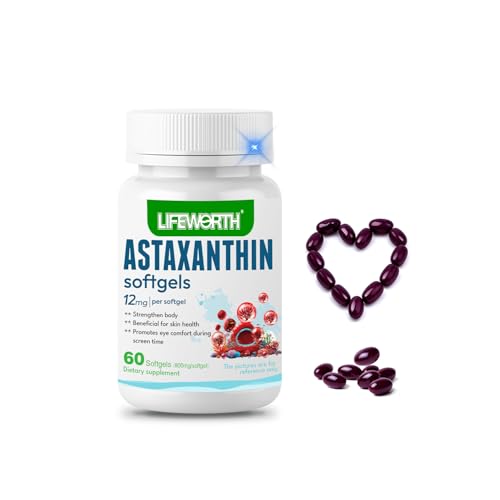
- Nutrex Hawaii BioAstin Hawaiian AstaxanthinLab-tested / studied
softgels, 12 mg per softgel, 90 count — Hawaiian-grown Haematococcus pluvialis, sold as the High Potency 90-softgel bottle - Pure Synergy SuperPure Astaxanthin Extract
capsules, 60 count — Sold as an astaxanthin extract in a capsule rather than a softgel; the listing does not state a mg per capsule, so check the label for the dose before comparing it with the 12 mg bottles here - Naturalis New Zealand Astaxanthin
softgels, 12 mg per softgel, 120 count — New Zealand-grown rather than Hawaiian, and the largest bottle on this list at 120 softgels - NOW Foods Astaxanthin
softgels, 4 mg per softgel — The entry-level 4 mg dose, built on the Zanthin astaxanthin ingredient; a lower starting point than the 12 mg bottles above
As an Amazon Associate we earn from qualifying purchases. Astaxanthin products vary mainly by dose and by source, with 4mg and 12mg the common strengths and most of them derived from Haematococcus pluvialis algae, so check the label for the astaxanthin content per serving and prefer products that publish third-party testing.
A Note on the Evidence
Human trials on astaxanthin are generally small and short-term; most evidence should be considered preliminary rather than definitive. Astaxanthin supplementation is not recommended during pregnancy or breastfeeding due to insufficient safety data, and anyone with a medical condition or taking prescription medications should consult a healthcare provider before starting supplementation.
Frequently Asked Questions
Is astaxanthin better than beta-carotene?
They are not directly comparable because they serve different functions. Beta-carotene is a provitamin A compound; astaxanthin is not. Astaxanthin’s membrane-spanning structure gives it a theoretical antioxidant advantage in lipid bilayers, but ‘better’ depends entirely on what outcome you are evaluating. Neither should be treated as a universal supplement.
Can I get enough astaxanthin from eating salmon?
Farmed salmon contains astaxanthin, but at levels far below those used in clinical trials (typically 4–12 mg/day). You would need to eat an impractical quantity of salmon daily to approach supplemental doses. Wild sockeye salmon has naturally higher astaxanthin content than farmed varieties, but food intake still falls well short of trial doses.
What is carotenodermia and is it dangerous?
Carotenodermia is a yellow-orange discoloration of the skin caused by carotenoid accumulation in subcutaneous fat. It has been reported with very high astaxanthin doses (above 20 mg/day) and is reversible upon stopping supplementation. It is not harmful in itself, but its appearance at high doses is a reason to stay within studied dosage ranges.
Is astaxanthin safe during pregnancy?
Evidence in pregnant and breastfeeding women is insufficient to establish safety. Supplementation is not recommended during pregnancy or breastfeeding. Anyone who is pregnant, trying to conceive, or breastfeeding should consult a healthcare provider before using astaxanthin.
How does astaxanthin's membrane-spanning ability matter practically?
Most fat-soluble antioxidants protect only the lipid interior of membranes. Because astaxanthin’s polar end-groups anchor at both the inner and outer membrane surfaces, it can theoretically intercept reactive oxygen species at more sites within the same membrane structure. Whether this structural property translates to proportionally greater protective effects in human tissue remains an active area of research.
Does astaxanthin interact with medications?
No significant drug interactions have been established in human trials to date, but the research base is not large enough to rule them out comprehensively. Astaxanthin may have mild effects on inflammatory pathways, which is relevant if you take immunosuppressants or anticoagulants. Always discuss any new supplement with a pharmacist or physician if you take prescription medications.
References
- Extensive Bioactivity of Astaxanthin from Haematococcus pluvialis in Human. Advances in Experimental Medicine and Biology (2021). PMID 33783748
- Astaxanthin: sources, extraction, stability, biological activities and its commercial applications – a review. Marine Drugs (2014). PMID 24402174
- Astaxanthin: How much is too much? A safety review. Phytotherapy Research (2019). PMID 31788888
- Astaxanthin for the Food Industry. Molecules (2021). PMID 34063189
These statements have not been evaluated by the Food and Drug Administration. This information is not intended to diagnose, treat, cure, or prevent any disease. Content is for informational purposes only and is not medical advice; consult a qualified healthcare provider before starting any supplement. As an Amazon Associate we earn from qualifying purchases.
