Age-related muscle loss is one of the few areas where astaxanthin has been tested in the population that would actually use it, with objective measurements, over months rather than weeks. Two randomized controlled trials in adults aged 65 to 82 report genuine gains in strength, muscle size, and endurance [1][2].
They also come with three conditions that product pages tend to leave out: the supplement was not astaxanthin alone, the gains only appeared alongside a training program, and the metabolic effects showed up in men but not women.
Key Takeaways
- In a randomized, double-blind trial of 42 adults aged 65 to 82, four months of a formulation containing astaxanthin 12 mg, tocotrienol 10 mg, and zinc 6 mg plus three months of incline walking produced a 14.4% rise in maximal voluntary contraction and a 2.7% increase in muscle cross-sectional area. The placebo group showed no change in either [1].
- Endurance and six-minute walk distance improved in both groups, meaning training alone accounted for those gains [1].
- In a companion trial, specific muscle endurance improved only in the supplement group (353 to 472 contractions), and the increase in fat oxidation was larger with the supplement, but the efficiency benefit appeared in men and not in women [2].
- A 2026 cell study found astaxanthin improved proliferation and myogenic commitment of aged human muscle progenitor cells more in male than female cells, pointing at an NRF2-SIRT3 axis [3].
- A separate krill oil trial that preserved lean mass during fasting supplied only 100 micrograms of astaxanthin per capsule, roughly one hundredth of a standard dose [4].
Why this matters more than a sports supplement question
Sarcopenia is the progressive loss of skeletal muscle mass and strength with age. It is not a cosmetic issue. Loss of strength predicts falls, loss of independence, and mortality, and once it passes a threshold it becomes self-reinforcing, because weakness reduces activity and reduced activity accelerates weakness.
The reason nutritional interventions get studied here is that resistance training works but adherence is hard, and older muscle adapts to training less efficiently than young muscle. Part of that gap is attributed to oxidative stress and an exaggerated inflammatory response to exercise, which is the specific opening astaxanthin was tested against. This is a different question from the acute soreness and recovery topic covered in our article on astaxanthin and muscle recovery.
The strength trial
Published in the Journal of Cachexia, Sarcopenia and Muscle, this trial randomized 42 healthy adults aged 65 to 82 to a daily oral dose of either the active formulation or placebo, for four months. From month two, participants trained three times per week for 40 to 60 minutes on an incline treadmill with progressively longer intervals [1].
Research note: In 41 adults with overweight losing weight by alternate-day fasting, krill oil kept fat-free mass and grip strength stable while placebo lost 1.2 kg of fat-free mass; the effect cannot be credited to astaxanthin, which was a minor component [4].
Strength was measured as maximal voluntary contraction in ankle dorsiflexion. Muscle size was measured as tibialis anterior cross-sectional area on MRI, which is an imaging measurement rather than a body-composition estimate, so it is about as objective as this field gets.
With the supplement: maximal voluntary contraction up 14.4%, cross-sectional area up 2.7%, and specific force, which is strength normalized to muscle size, up 11.6%. With placebo, none of the three changed, and the reported values sat well inside their own error margins [1].
The specific force result is the notable one. It says the muscle got stronger by more than it got bigger, which points at improved quality of contraction rather than simple hypertrophy.
The endurance and metabolism trial
The companion study in Physiological Reports used the same age range and a three-month endurance training program, assessing whole-body exercise endurance and fat oxidation via a graded exercise test with indirect calorimetry [2].
Specific muscle endurance in the ankle dorsiflexors improved only in the astaxanthin group, from 353 to 472 contractions. Submaximal graded exercise test duration improved in both groups by around 41%, so that gain belongs to the training.
The increase in fat oxidation at lower exercise intensities was larger with the supplement, 0.76 g versus 0.23 g. But the accompanying reduction in carbohydrate oxidation and improvement in exercise efficiency appeared in male participants and not in female participants [2].
A lab result that echoes the sex difference [6]
A 2026 study in npj aging looked at aged human muscle progenitor cells directly. Astaxanthin enhanced their proliferation and their commitment to becoming muscle, and the effect was more pronounced in cells from male donors than female donors [3].

The authors link this to differences in reactive oxygen species scavenging and mitochondrial function, and identify NRF2 and SIRT3 as candidates. NRF2 and SIRT3 both rose with treatment in cells from both sexes, but SIRT3 mitochondrial expression increased in male cells only.
A clinical subgroup finding and a lab cell result pointing the same way is suggestive, not proof. A cell experiment does not show that the sex difference in the training trial is real, and that trial had 42 participants [6].
The attribution problem
The formulation in both trials was astaxanthin 12 mg, tocotrienol 10 mg, and zinc 6 mg [1]. Tocotrienols are a vitamin E family with their own antioxidant literature. Zinc is required for protein synthesis and is a nutrient older adults are commonly low in.
Neither muscle trial tested astaxanthin alone
A three-ingredient formula
The test formula held astaxanthin (12 mg), tocotrienol (10 mg) and zinc (6 mg), taken with incline-walking training by 42 older adults.
A little astaxanthin, much else
Each capsule held 191 mg EPA, 94 mg DHA, 78 mg choline and 100 mcg astaxanthin.
No credit to astaxanthin alone
In both trials the benefit cannot be credited to astaxanthin by itself, because other active ingredients were in the capsule.
Check the ingredient list of a trial before crediting the headline ingredient.
Randomized, placebo-controlled trials in older adults (strength formula) and adults with overweight on alternate-day fasting (krill oil). Source: Wong et al., Experimental and therapeutic medicine 2020; Alblaji et al., Obesity (Silver Spring, Md.) 2025.
Chart: astaxanthinhub.com: Neither muscle trial tested astaxanthin alone
Embed this chart
Free to reuse on your site. Copy the code below; please keep the credit link.
No arm isolated astaxanthin. So the correct statement is that this specific three-ingredient formulation, combined with supervised training, improved strength and muscle size in older adults. Any narrower claim is an inference the trials do not support. We cover this pattern across the astaxanthin literature in our article on combination supplement studies.
A related caution applies to krill oil trials. A 2025 randomized trial found that krill oil during alternate-day fasting preserved fat-free mass and handgrip strength while the placebo group lost both. Each capsule contained 191 mg EPA, 94 mg DHA, 78 mg choline, and 100 micrograms of astaxanthin [4]. Each capsule held only 100 micrograms of astaxanthin, a tiny fraction of the 12 mg in a standard softgel [4]. Attributing that result to astaxanthin is not tenable, which is also the point of our astaxanthin versus krill oil comparison.
The exercise requirement is the headline
In both trials, the supplement group trained. There was no supplement-without-exercise arm. Every measured strength and endurance benefit occurred on top of a structured program of three sessions a week for three months.

That is not a limitation to gloss over, it is the practical finding. The evidence describes a supplement that improved adaptation to training, not one that built muscle in people sitting still. Anyone reading these results as a reason to buy softgels instead of starting a walking program has read them backwards.
A review of sarcopenia research describes human results for astaxanthin combined with other antioxidants as mixed, with both positive and negligible effects. In 20 resistance-trained men, a supplement of 4 mg astaxanthin plus 480 mg lutein for three weeks had negligible effects on muscle soreness or damage after eccentric exercise [6].
Common questions
Will astaxanthin prevent muscle loss if I do not exercise?
Nothing in these trials tests that. Both required a training program, and the endurance gains that appeared in the placebo group show how much of the benefit training alone delivers [1][2].
Does the sex difference mean it does not work for women?
No. In the strength trial, results were reported for the combined group and the gains were real. The sex difference appeared specifically in fat oxidation efficiency and carbohydrate sparing during exercise [2], and in cellular myogenic response [3]. Those are metabolic and cellular endpoints, not strength outcomes.
How long before anything changes?
Four months of supplementation and three months of training. These are not fast interventions, and the muscle cross-sectional area change of 2.7% over that period is small in absolute terms even though it was statistically significant against a placebo group that gained nothing.
Is 12 mg the right dose for this?
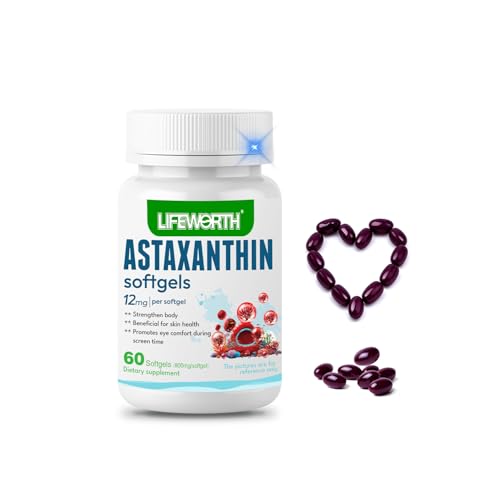
Twelve milligrams is what both trials used, within a formula that also contained tocotrienol and zinc. It is a common label dose, but above the EU supplement maximum of 8 mg/day [6][7]. Note that pooled antioxidant biomarker data finds significance mainly at 20 mg/day and above [5], so the 12 mg used in these combination-formula trials is below the threshold that shows up in oxidative-stress meta-analysis [6]. Our dosage guide covers the range.
References
- Building strength, endurance, and mobility using an astaxanthin formulation with functional training in elderly. Journal of Cachexia, Sarcopenia and Muscle (2018). PMID 30259703
- Astaxanthin supplementation enhances metabolic adaptation with aerobic training in the elderly. Physiological Reports (2021). PMID 34110707
- Astaxanthin improves myogenicity of aged skeletal muscle progenitor cells in a sexually dimorphic manner. npj Aging (2026). PMID 41519810
- Benefits of Krill Oil Supplementation During Alternate-Day Fasting in Adults With Overweight and Obesity: A Randomized Trial. Obesity (2025). PMID 40671417
- Effects of Astaxanthin Supplementation on Oxidative Stress. International Journal for Vitamin and Nutrition Research (2020). PMID 30982442
- Wong SK et al. Effects of astaxanthin on the protection of muscle health (Review). Experimental and therapeutic medicine (2020). PMID 32855659
- European Food Safety Authority (EFSA NDA Panel) Safety of algal meal from Haematococcus pluvialis containing astaxanthin as a novel food pursuant to Regulation (EU) 2015/2283. European Food Safety Authority (EFSA NDA Panel) (2025). source
These statements have not been evaluated by the Food and Drug Administration. This information is not intended to diagnose, treat, cure, or prevent any disease. Content is for informational purposes only and is not medical advice; consult a qualified healthcare provider before starting any supplement. As an Amazon Associate we earn from qualifying purchases.
